A Practical Guide to Killing Hallucinations, Engineering Better Outputs, and Becoming the Kind of AI User the Future Demands
By Chuck Nealis
INTRODUCTION: WHY THIS MATTERS

Let’s face it: most people are using AI wrong. They type vague questions, get semi-useful answers, and call it productivity. But vague inputs lead to vague outputs—and in a world that rewards precision, that’s a problem.
This guide isn’t for people who want to “see what AI can do.” It’s for those ready to take control. To stop prompting and start blueprinting. To build.
If you’ve ever been burned by hallucinated facts, embarrassed by inaccurate AI answers, or frustrated by inconsistent results—this is your playbook.
You’re not here to experiment. You’re here to execute.
Let’s get to work.
Chapter 1: Why Prompting Isn’t Enough
We’ve all done it—typed a prompt, hit enter, and watched the AI produce a beautiful lie. It sounded confident. It flowed well. But it was dead wrong.
This chapter is about understanding why that happens and why traditional prompting is fundamentally flawed.
AI isn’t a search engine. It doesn’t “know” anything. It’s a probability machine—assembling words in the most likely order based on your input. If your input lacks context, structure, and intent? You’re at the mercy of chance.
BrainGas: Asking AI a vague question is like yelling into a canyon and hoping a PhD shouts back.
Chapter 2: The Myth of the “Perfect Prompt”

Everyone’s searching for the perfect prompt—the magical string of words that unlocks genius.
But here’s the truth: prompts don’t work in isolation. They need scaffolding. They need context. They need constraints.
That’s why we blueprint.
Blueprinting means defining the outcome, building the structure, setting guardrails, and THEN using AI to fill in the blanks. You don’t prompt—you architect.
BrainGas: A good prompt is like a recipe. A blueprint is the entire kitchen, stocked with tools, ingredients, and instructions.
Chapter 3: How the Redundant Verification Process Was Born
While working on my first book on Amazon, Instructional Design COMPANION, I ran into a wall.
Claude and ChatGPT made up the best stories—believable but not true. I tried everything to avoid hallucinations: short sessions, better bandwidth, re-prompts. But they kept happening.
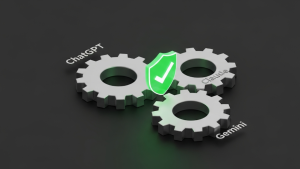
Then came the lightbulb moment: Claude and ChatGPT are creative. Gemini is factual.
So I started using Claude or ChatGPT for drafting, then verifying everything with Gemini. Hallucinations disappeared.
Thus, the Redundant Verification Process was born.
BrainGas: ChatGPT dreams. Claude imagines. Gemini checks their math.
Chapter 4: CustomAIEngines—Where Blueprinting Becomes Business

When I launched CustomAIEngines.com, I wasn’t building a chatbot. I was designing AI systems trained on real workflows—documents, SOPs, use cases, structured prompts.
And by “I,” I mean me—plus ChatGPT, Claude, and Gemini. No staff. No interns. Just one instructional designer and a few silicon co-pilots.
The key? Control the input to lock down the output.
Take LeAnne, a Repository AI. She helps new hires access policies without hallucinating—because she only answers from approved internal sources.
Even then, phrasing matters. I found prompts using “Must” produced more factual accuracy than “Will” or “Shall.”
BrainGas: If you want facts, stop asking the AI like it’s your buddy. Ask it like it’s your paralegal under oath.
BrainGas: AI hallucinations disappear when you cut off their imagination and give them homework.
Chapter 5: PerfectPrompter—When You Need the Prompts to Work Every Time

Not every business needs a full AI engine. Some just need better prompts.
That’s why I created PerfectPrompter.com. It’s a library of zero-fluff prompt blueprints for instructional designers.
Each framework walks you through:
-
Defining the goal
-
Stating the format
-
Providing context
-
Setting constraints
-
Layering logic
-
Output testing
-
Redundancy checks
BrainGas: You wouldn’t let a stranger write your lesson plan. Why let AI improvise your training content?
Chapter 6: Becoming the Blueprint Architect

AI won’t replace you. But someone who knows how to use it better might.
If you want to be future-proof, move from user to architect. From input to outcome. From prompt to plan.
Being a blueprint architect means:
-
Framing objectives
-
Anticipating edge cases
-
Building feedback loops
-
Testing relentlessly
BrainGas: Prompting is passive. Blueprinting is power.
Chapter 7: Case Study (Hypothetical)

What Happens When You Don’t Blueprint?
A healthcare company deployed an AI assistant for HR onboarding. It wasn’t blueprinted—it was just “smart.”
It told a new hire they had unlimited PTO. They didn’t. Cue legal, PR, chaos.
Now imagine if it had:
-
Documented PTO policy
-
Pre-vetted responses
-
Verified logic paths
-
Context by role
Different story.
BrainGas: Bad prompts don’t just waste time. They break trust.
Chapter 8: Closing Thoughts—The Future Isn’t Prompted, It’s Blueprinted

Working on Instructional Design COMPANION, AI helped—but it also hurt. Hallucinations, contradictions, false citations.
Then came the Redundant Verification Process.
Now I expect hallucinations—and I catch them. I don’t guess prompt structure—I engineer it.
This isn’t about tools. It’s mindset.
This isn’t about AI replacing humans. It’s humans learning to partner with AI.
If you’ve read this far, you’re not just a reader—you’re a builder.
Use this system. Break it. Adapt it. Teach it.
BrainGas: Stop Prompting Like an AI Noob. Start Building Like an AI Architect.
You’re not typing suggestions anymore. You’re architecting outcomes.
Want the Tools I Use?
If this guide resonated, you’ll love what I’ve made available for free:
👉 Download my hallucination-killing frameworks at PerfectPrompter.com
No fluff. No gimmicks. Just tools that work.
Let’s build something great—together.
0 Comments